Why I’m Not Entering #Pitchwars – But Why You Should!

About a year ago, I cried during dinner because I didn’t get accepted into #Pitchwars. I didn’t understand. I revised my manuscript tirelessly for two full months! I was active on social media and was making all kinds of friends! How could I not get chosen?

giphy

Well. There are plenty of reasons, all of which we won’t waste time getting into. Once I had taken some time to lick my wounds, I pulled open my next manuscript, which had started off as my 2015 NaNoWriMo, and completed the first draft in September. With nearly a full year ahead of me to revise (properly), I was confident I’d be entering this new manuscript into #Pitchwars.

But here we are, less than a month before the #Pitchwars submission window opens and all I have is that first, rough draft.

So what happened?

A number of things.  First, thanks to #Pitchwars, I found a lot of fabulous critique partners. I didn’t use my newfound writer friends to go through my newly completed manuscript, though. Instead, I workshopped my #Pitchwars manuscript. I think a total of seven (possibly more) fantastic critique partners combed through my #Pitchwars manuscript and provided me with amazing feedback. So instead of revising my new manuscript, I focused my efforts on revising the old.

I entered the query trenches in Fall 2017 with my first manuscript and was ready to roll up my sleeves and revise the new one. But as the rejections trickled in, I kept nitpicking at the first manuscript, kept sending it off to new CPs. In short, I couldn’t give up.

giphy (1)

At the start of 2018, I continued querying and started preparing myself to enter a revision cave for my next WIP. I still had about six months before #Pitchwars—plenty of time to get my manuscript in tip-top condition.

Again, I couldn’t stop going back to my first manuscript.

In April, I was fortunate enough to have my original #Pitchwars manuscript (now very revised and in the type of shape it should have been in for #Pitchwars 2017) chosen by a mentor in #AuthorMentorMatch. I think at this point, I knew my chances of getting Manuscript #2 ready for #Pitchwars was behind me.

From April until very recently, I revised and revised and revised. In all honesty, I worked my butt off—a lot harder than I’d ever worked before. And I think—and hope—the work shows.

But that manuscript I finished back in September for #Pitchwars 2018? It’s still there in first draft format. For about a day I thought maybe I could bust my butt and get it ready in time for #Pitchwars but it only took a few minutes before I decided that’s not going to work for me.

So there you have it. Why I’m not entering #Pitchwars this year.

BUT… I think YOU should!

giphy (2)

I’ve had a few friends tell me they’re intimidated by #Pitchwars.  Or that they don’t think it’s for them. But I’m here to tell you that even though I didn’t get into #Pitchwars last year, my manuscript, currently out with agents and chosen to be mentored through #AuthorMentorMatch, wouldn’t be where it is today had I not thrown my hat into the ring for #Pitchwars.

There’s a number of reasons #Pitchwars is a great experience.

REASON #1: It’s a learning experience.

If you’ve never queried agents before, #Pitchwars is a great way to get your feet wet, so to speak. Like querying agents, you have to follow submission guidelines. You have to prepare a submission package (query letter, synopsis, first pages). You might get a full request from one of the mentors (woo!). You might not.

You might not get chosen to participate in #Pitchwars, aka, you might, like me, get rejected.

Rejection is hard, but it’s also a part of the business. Being afraid of rejection isn’t going to get your book on the shelf. You’ve got to face that fear head-on and #Pitchwars is a safe, friendly way to go about it.

In other words? #Pitchwars is a way to test your submission package without “burning a bridge” or hurting a chance with an agent. This is key. Trust me. When I first started querying agents, I was querying a first draft. That’s a nuh-uh move. If only I’d tested it out with #Pitchwars first!

giphy (3)

REASON #2: #Pitchwars makes you set a deadline.

It’s a little too late in the game for this, but #Pitchwars is a great motivator. Last year, I started seriously revising my manuscript with the #Pitchwars submission date as my target goal to have completed revisions. Without this deadline? I might have never finished this particular round of revisions.

Even if you are running out of time, use the #Pitchwars submission date as a target to get somewhere new in your draft—whether it’s completed revisions so you can enter or whether it’s to get a draft written so you have a full year to revise for next year’s #Pitchwars, if you need a swift kick in the butt, #Pitchwars might just offer that.
tenor

REASON #3: The community.

This is the biggest reason, in my opinion. Going into #Pitchwars, I had a few friends, a few CPs. After #Pitchwars? I had an entire community of friends and CPs, not to mention tons of resources I didn’t have before. A lot of really great people in the community offer query critiques, too. This is INVALUABLE, you guys. INVALUABLE.

Plus, it’s important that you don’t feel alone in the cold world of writing. We writers are famous for liking solitude, but the loneliness can get to us, especially if we’re facing rejection or if we’re stuck in a rut. Fellow writers know what we’re going through—and they can help us through. Or at least help us feel less lonely.

As far as I can tell, Tweeting using the #Pitchwars hashtag and following along with #Pitchwars games is the best way to instantly become connected to hundreds (thousands?) of writers like yourself. Find your people—they’re likely out there under the #Pitchwars hashtag. ❤

giphy (4)

REASON #4: You’ve got nothing to lose.

Seriously. Take it from me, someone who did not make it into #Pitchwars and who took it pretty hard. (After crying I played in a tennis match and tried to vent my frustrations that way—it’s never fun chasing a ball three courts down.) But guess what? I didn’t lose anything. In fact, I gained a lot. One of the mentors I had subbed to was kind enough to set me up in a critique group, which I’m still involved in today (love my GWB ladies! <3). One of my CPs knew more about my novel’s subject matter than I did (*gulp*) and she helped tremendously with my revisions and is now a #Pitchwars mentor herself. You grow as a writer by entering #Pitchwars—trust me on this.

 Also, so what if you don’t get chosen? There are still plenty of opportunities ahead, starting with #PitMad in September. The query trenches are always open, never closed.

And of course I have to boost #AuthorMentorMatch because Round 5 starts in the fall. Don’t get into #Pitchwars? Have no fear. Polish that manuscript off, revise according to all of the great feedback you get during the #Pitchwars submission period, and enter #AuthorMentorMatch. I’ll be writing a separate post on how amazing and beneficial #AuthorMentorMatch is, so stay tuned for that.

In the meantime, roll up your sleeves, set your deadlines, interact with some people and the #Pitchwars hashtag, and know that I’m cheering for you from the sidelines!

tenor (1)

05.18.17 – Writing when your life is incredibly busy

I’m currently in the middle of moving and exactly a week today I begin my travels for my much-awaited Disney Baltic Sea Cruise.  Boxing up all my stuff, moving it into my new apartment, and prepping for Europe in two weeks?  Plus working a full time job that’s fairly demanding?  However am I supposed to write?

Before I list out some ideas on how to sneak in a few words despite a busy schedule, I do have to admit that sometimes I do “writing activities” that aren’t actually writing but make me feel like I’m being productive.  I’ll touch base with fellow writers on Scribophile and do some critiques of other writer’s works there.  I’ll hash out some ideas with friends while we’re hanging out or via email.  And I’ll complain about writing to my boyfriend even though I’m not actually writing (that’s productive, right?).  Even 15 minutes of critiquing someone else’s work on Scribophile helps me earn points (or “karma” as it’s called on Scribophile) which allows me to later post my work for critiquing.  So ultimately it’s still about my work.

Anyway, without further ado, here are a few of my personal tips for getting some words written despite a crazily busy schedule.

(1) Utilize that lunch break.  Get an hour for lunch?  That’s an hour you can be writing.  Or even thirty minutes you can be writing.  Or, heck, fifteen minutes.  Whatever you can squeeze in.  I pack my lunch every day and once the noon bell rings I eat at my desk and pull up my manuscript.  My productivity level varies, but I will tell you that I was averaging 1000 – 3000 words on my lunch break during NaNoWriMo.  Not too shabby.  Bonus points?  Your boss might assume you’re working.

(2.) Skip the TV watching.  I know, I know, it’s great to just get home from a long day at work and mindlessly watch some TV.  My guilty pleasure is The Bachelor (not afraid to admit it).  But the Bachelor is only on Monday nights (starting next week yay!) so what’s my excuse for the rest of the nights?  Instead of watching an hour of mindless TV, limit yourself.  Don’t Netflix binge.  Watch one episode or even a half of an episode.  Or write during commercial breaks.

(3.) The Self-Control App.  Have you ever found yourself without wifi connectivity on your laptop and discovered that you’re actually way more productive without the interwebs at your fingertips?  The Self-Control App works the same way, while allowing you to use Spotify or Pandora, which are websites I use for some inspiring music while writing.  I had a roommate during law school who used this app when she was studying for tests or finals, and I used it daily while studying for the Bar Exam.  It’s helpful not only in that it blocks out your distractions (which you can set yourself to create the ultimate distraction-free setup) but also, for me, acts as a timer and lets me know when I can take a break.  For example, during my study sessions for the Bar Exam, I set the Self-Control App at 2 hours.  I would study nonstop for those 2 hours and as soon as the time was up and my web applications were unlocked, I took a fifteen minute break to check my email and browse through social media and what have you.  It works that way for writing, too—only got an hour to write?  Set that Self-Control app up for an hour to keep yourself on schedule.

(4.) Leave your house.  Guys, I cannot tell you how many times leaving my house has increased my productivity levels.  When I’m home, all of a sudden I’m looking for any excuse to do anything other than write.  Oh, does the whole house need to be clean?  I’ll start cleaning.  Oh, there’s the TV glaring at me.  I’ll just watch one show.  Just one.  Etc. etc. etc.  When I’m home, there are distractions all around me.  Family members, boyfriends, roommates, etc. etc. etc.  I know this list is full of tips on how to write when you’re insanely busy and it’s hard to find time to leave the house, but if you have an hour free, it’s an easy way to practically ensure you won’t spend that hour watching TV or cleaning out the fridge (that can always be done later, trust me).  Plus, if I’ve gone to Starbucks, or Panera, or Barnes & Noble’s café (my personal favorite but their internet is always sluggish), that means I’ve spent some money on some drink.  I don’t want to feel like I’ve not only wasted my time but also wasted money.  So it’s an extra incentive to get to work.

(5.) Reward yourself.  I don’t actually do this, but I’ve heard it said time and time again that if you know you’ll get a reward, you’re more than likely to want to earn that reward.  Set up a reward system.  Maybe you treat yourself to a writing session at Starbucks after you’ve written a certain amount of words where you’ll get that venti iced chai tea latte with soy (my go-to).  Making goals and rewarding yourself isn’t just about the rewards—it’s also about the goals.  Just setting up a list of goals in and of itself helps you see your project big-picture and see where you need to go.  Write it out.  Then you can see how far you have to go but also see your progress.  And progress is rewarding in itself, am I right?

And there you have it.  My tips to being productive and getting some writing done even when you’re insanely busy.  I will make a confession though: other than the writing on my lunch break thing, I haven’t been utilizing any of these tips.  But making this list helped remind me that it’s important to be productive, and while it’s hard to start now with a vacation looming over my head, I can’t wait to get a fresh start in June!

Happy writing!

04.17.17 – Revision, Revision, Revision

Have you ever had to kill a character?  And I’m not talking about killing the character within the bounds of your manuscript – you know, causing him or her to be killed in an automobile accident, or by a shooting, or heart attack.  I’m talking about creating a character and then taking away his entire existence.

Removing him from the manuscript, removing him from being a character at all.  Killing a character at least gives him a place – removing him takes him from being something to being nothing.

A friend of mine recently read through one of my works and suggested merging two of the characters into one character.  At first I was shocked – she wanted to me to get rid of one of my characters?  In a way, it was like getting rid of two of my characters.  And I’m not talking minor characters here.  Well… okay, they’re kind of minor, but at least one of them appears in every chapter.  And she wanted me to just merge them into one?

Once the initial shock of the idea wore off, though, I realized that I kind of liked it.  I kind of liked the idea.  I even jotted it down in my notes for something to consider.

A few days later, I had the most generous, sweet literary agent ever provide me with some notes on my manuscript (and the politest rejection of representation I’m likely to ever receive – which, you know, stung, but I’ll take the gift of all of her super helpful notes), and I realized she was essentially suggesting the same thing – that I could merge these two characters.  (I don’t know that she actually suggested merging, but she suggested that I didn’t need them in the way they existed in that draft.)

And so, for about a week now, I have been dutifully working on a major revision of my novel.  A major revision.

Guys, I’ve never done a major revision before.  I’ve never merged two characters into one.  So far it’s been a bit easier than I was originally imagining, but every time I do a find + replace to merge the character into one (I took one character’s first name and combined it with the other character’s last name) I do feel a little sad.  I want to cling to the novel as it was, the novel I was so proud of.

I’ve also been compiling new songs into the playlist for this novel, adding the new in with the old.  The entire mood of the playlist is changing, just like the tone of the novel is changing.  It’s not the novel I wrote as a break from studying for the Bar Exam anymore.

But, I do believe it’s going to be a better novel.  It is a different novel, but it’s a better novel.  And, on the bright side – it’s the first time I’ve been truly excited about this novel since I finished it back in 2014.  So – guess I’ll keep on killing of that character.  Or, well, parts of both characters…

04.13.17 – Keeping Yourself Accountable

How do you guys keep yourselves accountable when it comes to writing?  I have to admit, I’m not particularly good at it.  It seems like some months (or weeks) I just have better success with writing than others.  Sometimes I can’t stop clicking away at the keyboard… and other times I just stare at that blinking cursor.

One way I keep myself accountable is by the use of a Bullet Journal. I have two bullet journals that I keep with me at all times – my daily bullet journal, which acts as a planner, and my writing bullet journal, which is where I jot down notes here and there. I don’t use my writing bullet journal regularly at all and unlike my daily bullet journal, which I spend hours and hours designing, coloring, and drawing out perfectly straight lines with a ruler, my writing bullet journal is not pretty or decorative at all. Half the time I only use black pens and don’t even jazz it up with color.

It’s through my daily bullet journal, though, not my writing bullet journal, that I try to keep myself accountable when it comes to writing. Every month, I, along with many other bullet journalers out there, do a “habit tracker” where I track my habits. For me, this includes making my bed (which I have done since starting a habit tracker without fail), eating at home (I used to eat out so much – and still kind of do), flossing (eek!), exercising (which I’m also bad at doing, excluding my weekly tennis lessons), taking vitamins, and then reading and writing.

I think reading is just as important as writing. I could write an entirely new blog post on how I went from bookworm to hardly ever picking up a book. I’ve been trying to change that and forcing myself to read more and enjoy more books, so I also track accountability on reading.

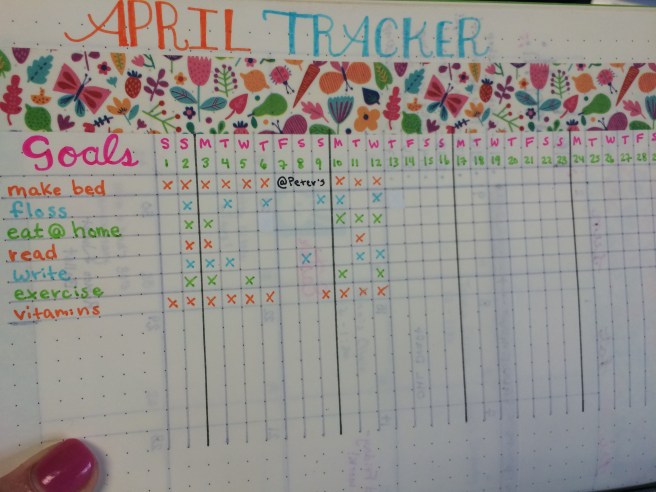
Here’s where my April tracker is thus far:

April Tracker
(How cute is that washi tape I found in Target’s dollar section?)

As you can see, I don’t write every day.  The worst part is, I used to be incredibly strict about how I marked off for writing in my tracker – that meant I had to have written 500 words or more of a current WIP or a new story.  This month, I have changed it up a bit – if I write something, even something short, that I’m proud of, I mark off for writing.  If I work on editing, I mark off for writing.  If I draft up a query or something to that extent, I mark off for writing.  Still, we’re about halfway through April and I’ve only “written” 6 times??

The more alarming revelation from my tracker is how little I’ve read this month.  I wish I had a picture of the pile of books by my bed, all of which I have at least glanced at (and one which sustained some severe water damage – can’t wait to explain that to my librarian), but none finished.  I go through these phases where I just can’t seem to get into anything…

…that said, even though I have done a limited amount of reading this month, I have been reading more of the genre that I want to write, and while I obviously do not steal the voices from the authors in my own writing, I do feel as though reading works by others helps make my own writing stronger.  This isn’t a new revelation, but something I have to work hard to keep in mind.

Back to writing.  Another way I’ve tried to hold myself accountable is by setting a daily word goal or the like, and detailing in a calendar view how many words for that day I wrote.  Let me put it this way – this never works out for me.  Ever.  (1) I don’t like to force myself to write if I’m not feeling it and (2) even if I do write every day, I’ll forget to update the calendar.

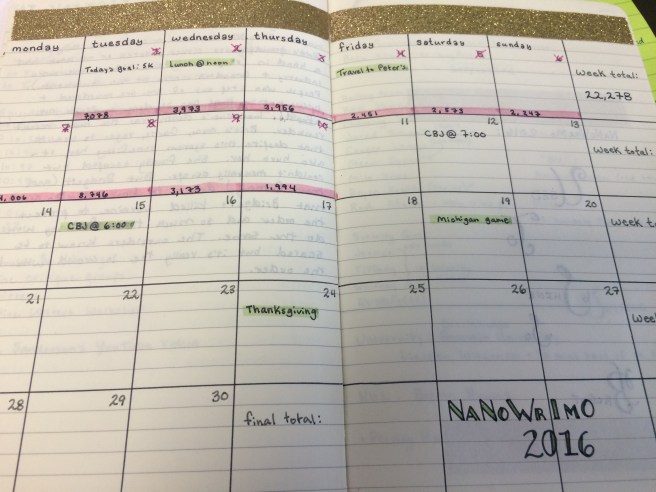
Here’s my example from this past November, when I completed NaNoWriMo:

NaNo Tracker

According to my stats from this past year’s NaNo, I reached 50,000 words by November 15, and it looks like I updated my word count every day. However, this is not revealed by looking at this calendar – which clearly just goes to show that I stopped updating.

I’ll keep playing around with ways to keep myself accountable.  I know many people have writer friends, but my writer friends and myself seem to encourage each other not to write sometimes (haha) because we know how difficult it can be.  In the meantime, my tracker is a pretty good indication to me on whether or not I need to get my butt into gear and… WRITE!

(Don’t be this guy ha! :))

*In case anyone is worried about this Peter fellow and why my bullet journal indicates I’m traveling to see him or at his place, he’s just my boyfriend. We’re long distance – talk about interfering with my writing schedule! But, I do come up with some good ideas on the 4-hour drive to see him! 🙂